Poster · 2022
Clinically Interpretable Severity Estimation of Facial Expression Impairment in Parkinson’s Disease
Y. Dushin, G. Morinan, G. Sarapata and J. O’Keeffe
Objective
Develop a scalable and interpretable computer-vision based algorithm to measure the severity of hypomimia in Parkinson’s disease (PD).1
Background
Neurological disorders frequently manifest themselves through impairment, or loss, of facial expressions. Consequently, facial expression examination is a component of routine assessments such as the Movement Disorder Society (MDS) Unified PD Rating Scale (UPDRS). Such assessments require rating by highly trained clinicians and take significant time to perform, making them unscalable and operator dependent.
Methods
We used markerless facial keypoint detection to extract biomarkers from videos (N = 430) of routine assessments of Parkinson’s disease patients. Patients were rated by an experienced clinician on the UPDRS (0–4) at five separate clinical sites and recorded using commercially available mobile devices. Our derived set of features characterises the general movement of the face as well as relating facial movements to emotions and facial muscles using Action Units (AUs).2 Two distinct parts of the UPDRS facial expression assessment, patient at rest and patient speaking, were considered separately. A random forest model was then applied to provide an estimate of the severity as well as interpret the importance of individual features.3
Results
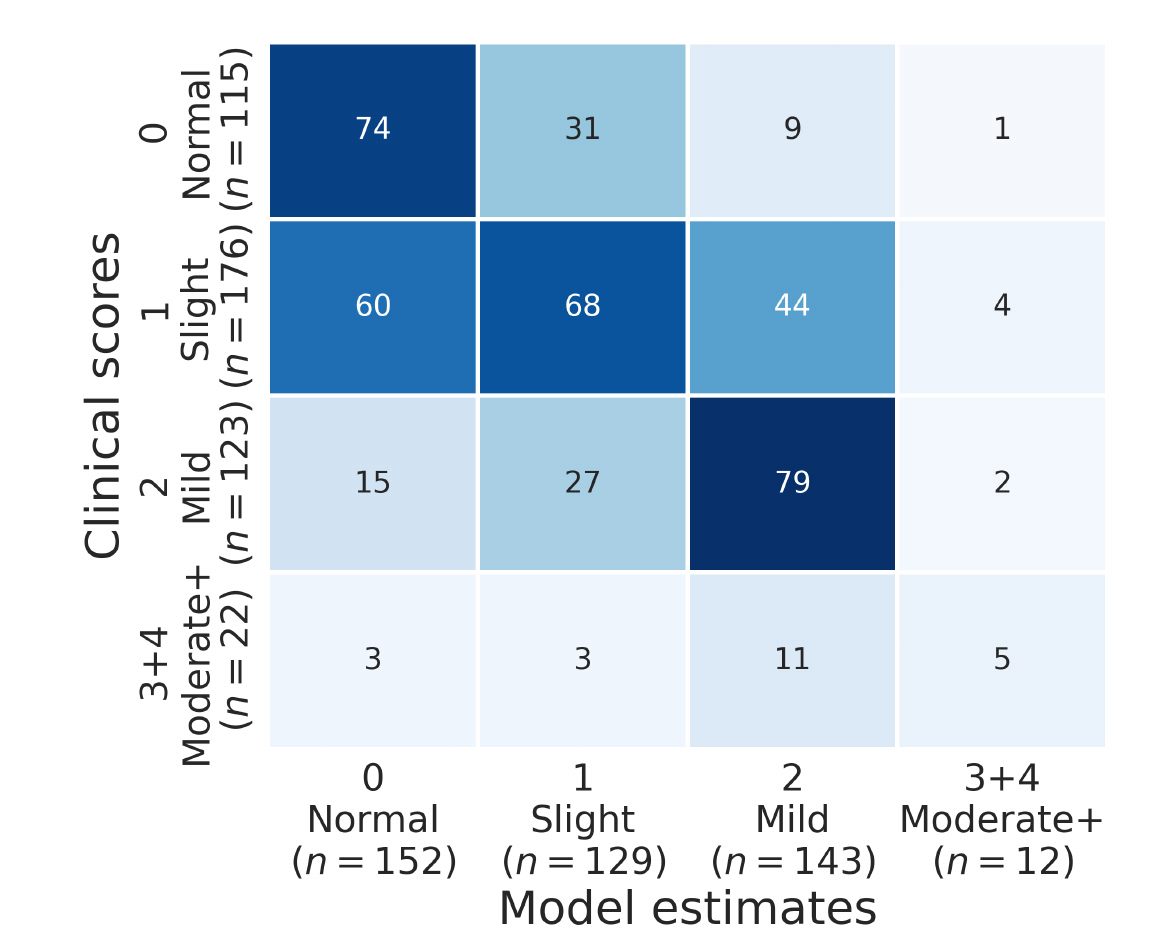
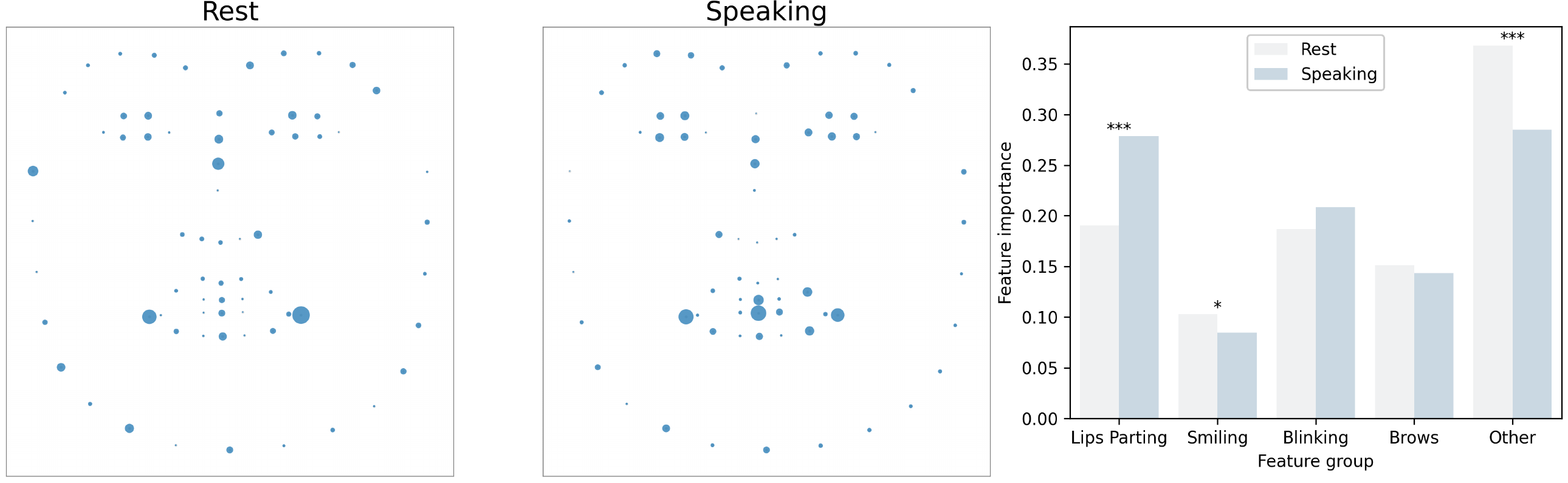
Our model achieved 47.7% balanced accuracy for severity prediction with 72.6% accuracy in detecting impairment (Figure 1). Mapping of the features’ importance to facial keypoints indicates that eyes, brows and mouth areas are the most important to estimation (Figure 2). This concurs with the MDS-UPDRS instructions.
Conclusions
Computer-assisted facial expression can provide cost-effective scalable routine assessments to patients with clear applications in telehealth. Moreover, this could be done using short video clips recorded using commercially available hardware.
References
- Argaud, S., Vérin, M., Sauleau, P. & Grandjean, D. Facial emotion recognition in Parkinson's disease: a review and new hypotheses. Movement Disorders 33, 554–567 (2018).↑
- Ekman, P. & Friesen, W. V. Facial Action Coding System. Consulting Psychologist Press, Palo Alto, CA (1978).↑
- Louppe, G. et al. Understanding variable importances in forests of randomized trees. Advances in Neural Information Processing Systems (2013).↑
About this poster
This research was originally presented as a poster by Machine Medicine Technologies. This HTML version has been reformatted for accessibility and web presentation, while preserving the content of the original poster.