Poster · 2023
Inferring Rigidity Scores in MDS-UPDRS Motor Assessment from Other Items
F. Duque, Y. Dushin, G. Sarapata, S. Komarov, A. Matveev and J. O’Keeffe
Objective
This study aimed to explore the possibility of inferring rigidity scores in MDS-UPDRS assessments from other items, to enhance the accuracy of clinical evaluations in situations where retrieving all scores may be unfeasible.
Background
Remote assessment of Parkinson’s disease with the MDS-UPDRS scale has been challenging due to the physical handling required for scoring rigidity and postural stability. Previous studies have suggested that rigidity may not be inferable from other items.1,2 However, theories imply that rigidity and bradykinesia share underlying processes.3,4,5
In this study, we decided to implement a more advanced methodology to accurately determine the predictability of rigidity scores using other assessment items, in hopes of enhancing the accuracy of clinical evaluation settings where retrieving all scores may be unfeasible.
Methods
We used moderate and severe patients6 from the PPMI dataset7 and fitted a random forest classifier for each item in each cardinal group (rigidity, tremor, bradykinesia, axial symptoms). The total predicted score was calculated for each group and compared with the real group score and real total motor score. Inter-rater ICC (calculated with data from8) was used as the gold standard performance, while a random imputation of scores was used as control.
Results
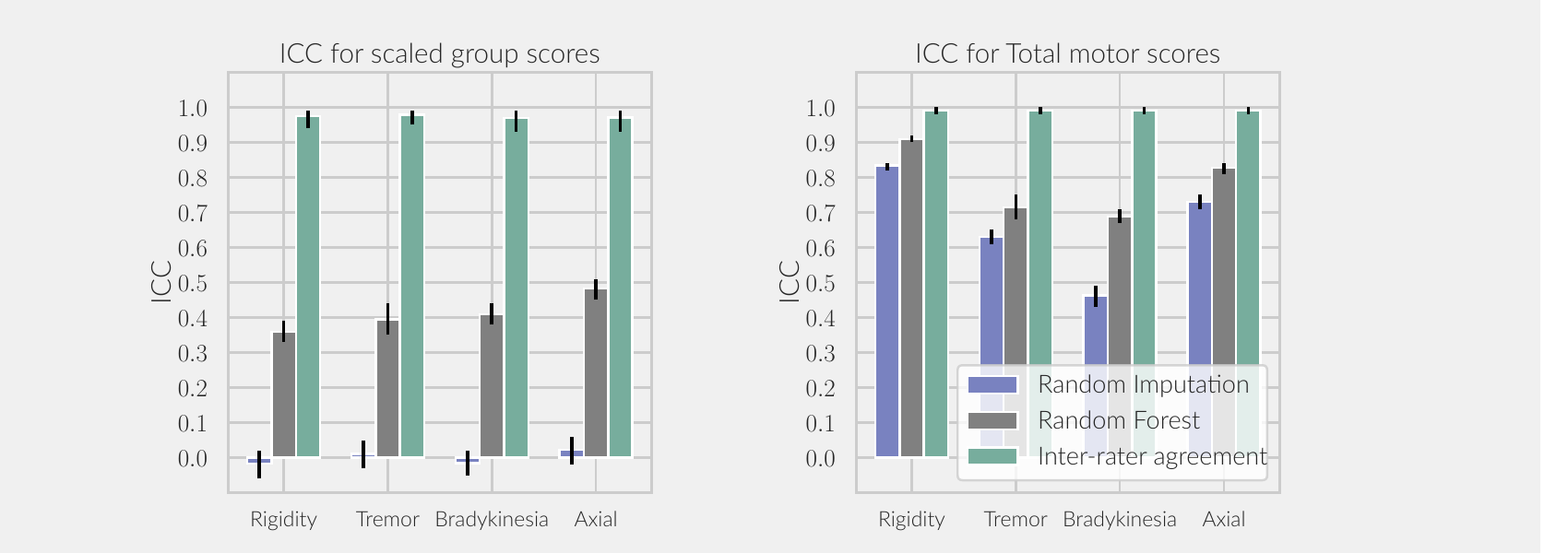
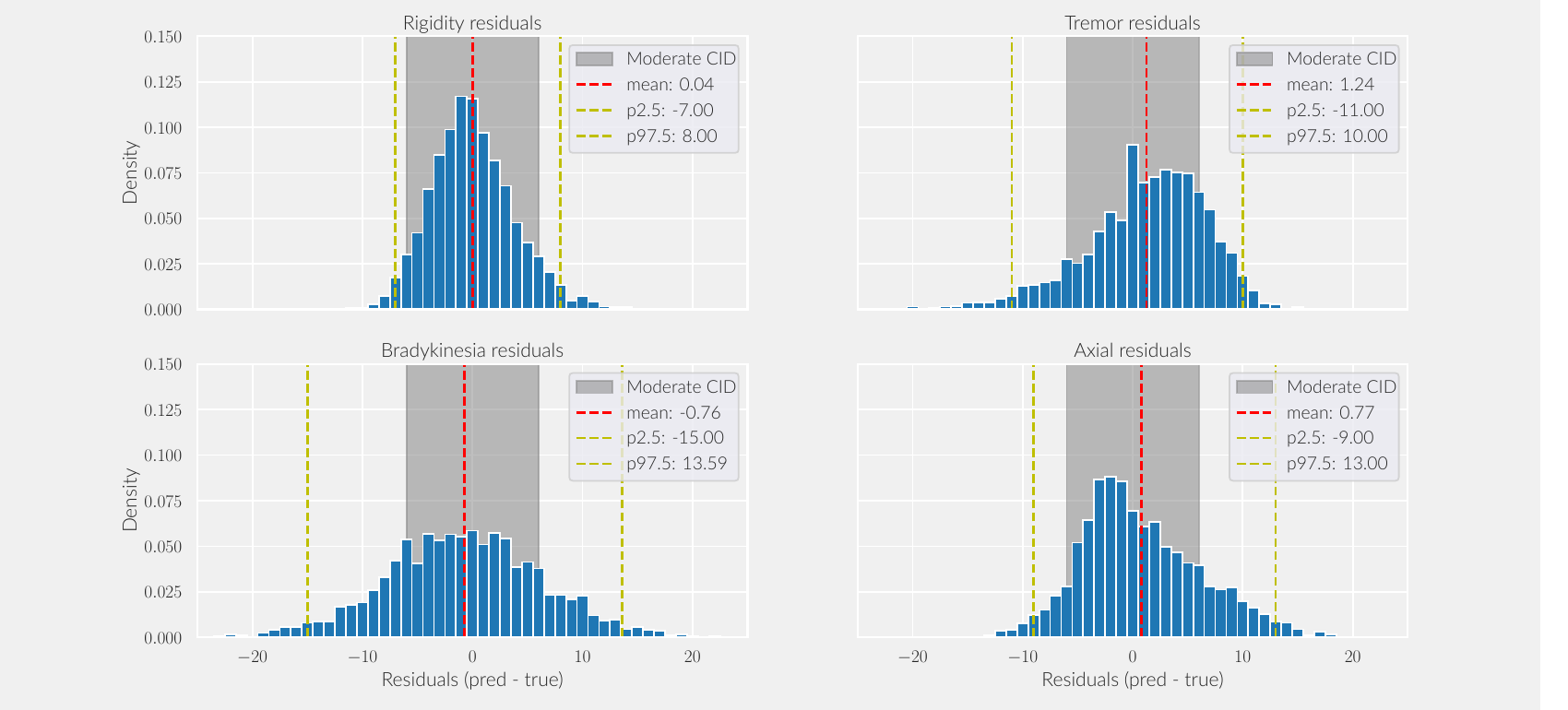
The inferred group score for rigidity performed proportionally worse than other groups, but the total retrieved information was sufficient to achieve an agreement above 90% with the real total motor score (seeFigure 1). While the balanced accuracy for individual item prediction was low for all groups (see Table 1), 91% of the residuals for rigidity were within the range of a moderate clinically important difference (CID)9 (see Figure 2), whereas less than 80% of other groups’ residuals fitted within this range.
| Group | Min balanced accuracy | Mean balanced accuracy | Max balanced accuracy |
|---|---|---|---|
| Rigidity | 0.335 | 0.395 | 0.469 |
| Tremor | 0.262 | 0.311 | 0.367 |
| Bradykinesia | 0.359 | 0.399 | 0.427 |
| Axial | 0.318 | 0.373 | 0.466 |
Table 1: item specific performance per Parkinson's canonical group. Minimum and maximum balanced accuracies were calculated among each group's items.
Conclusions
Our findings demonstrate that it is possible to recover some of the lost information for all canonical groups, including rigidity, with a performance that exceeds chance. However, we confirm that rigidity, like any other canonical group, cannot be reliably deduced from other groups’ ratings with enough certainty to avoid the risk of mislabelling a clinically significant difference.
Despite this, in the context of a full motor assessment, rigidity accounts for the least information compared to other groups. No advantage was found for the inference of rigidity or bradykinesia, as per the ICC metric (Figure 1, left). On the assumption that rigidity and bradykinesia share an underlying mechanism, this is a surprising result and may be considered as evidence against this hypothesis. Our study enhances the comprehension of the constraints in accurately predicting rigidity scores from other assessment items, which can impact clinicians’ evaluation of Parkinson’s disease patients with incomplete data.
References
- Lin, Z., Guo, R., Zhang, C., Li, D., Qian, X. & Sun, B. MDS-UPDRS-III item-based rigidity and postural stability score estimations: a data-driven approach. Parkinsonism & Related Disorders 94, 13–14 (2021).↑
- Luo, S., Goetz, C. G., Choi, D., Aggarwal, S., Mestre, T. A. & Stebbins, G. T. Resolving missing data from the Movement Disorder Society unified Parkinson's disease rating scale: implications for telemedicine. Movement Disorders 37, 1749–1755 (2022).↑
- Berardelli, A., Rothwell, J. C., Thompson, P. D. & Hallett, M. Pathophysiology of bradykinesia in Parkinson's disease. Brain 124, 2131–2146 (2001).↑
- Raza, C., Anjum, R. & ul Ain Shakeel, N. Parkinson's disease: mechanisms, translational models and management strategies (2019).↑
- McGregor, M. M. & Nelson, A. B. Circuit mechanisms of Parkinson's disease (2019).↑
- Martínez-Martín, P., Rodríguez-Blázquez, C., Alvarez, M. et al. Parkinson's disease severity levels and MDS-Unified Parkinson's Disease Rating Scale. Parkinsonism & Related Disorders 21, 50–54 (2015).↑
- The Parkinson's Progression Markers Initiative (PPMI). Parkinson's progression markers initiative.↑
- Sibley, K., Girges, C., Candelario, J. et al. An evaluation of KELVIN, an artificial intelligence platform, as an objective assessment of the MDS-UPDRS part III. Journal of Parkinson's Disease 12, 2223–2233 (2022).↑
- Shulman, L. M., Gruber-Baldini, A. L., Anderson, K. E., Fishman, P. S., Reich, S. G. & Weiner, W. J. The clinically important difference on the Unified Parkinson's Disease Rating Scale: six hundred fifty-three patients with PD. Archives of Neurology 67, 64–70 (2010).↑
About this poster
This research was originally presented as a poster by Machine Medicine Technologies. This HTML version has been reformatted for accessibility and web presentation, while preserving the content of the original poster.